Site still under construction
e-mail: Callegaris@optonline.net"Sandro Callegari trained as a scientist but an artist at heart."
Sandro Callegari was born in Venice, Italy. After graduating from the University of Bologna, he came to the United States. His work is influenced by the high technological aspect of the American culture as well as the warm colors of the Italian landscape. He has shown his work in Italy and United States. He lives and works in Yorktown Heights.
“Abstract paintings by an artist with a unique crayon touch”
The Yomiuri
America, January 15, 1993
“While the design suggests electronic
circuitry, the buildup of paint in warm earth tone adds a sensuous
quality”
Eileeen Watkins, Sunday - Star Ledger, New Jersey, 1992
“Hard
edges and shapes of modern technology next to a painting technique that is warm
and sensuous”
Sun-Bulletin, New Jersey, 1994
Selected Exhibitions
Joya Art, Brooklyn NY, 2003
Westchester Art Center, Group show, White Plains NY, 2001
William Paul Fine Arts, Katonah, NY, 1997
Westbeth Gallery, ”The Art of Science...The Science of Art”, NY, 1996
Rudy Art Castle (permanent exhibition), Capodimonte, Italy, 1995
University College Art Gallery, Fairleigh Dickinson University, Teaneck, NJ, 1994
Marino Roncari Gallery, Yorktown Heights, NY, 1994
Galleria La Bottega, Ravenna, Italy, 1993
Cast Iron Gallery, New York, NY, 1993
William Carlos Williams Center for the Arts, Rutheford, New Jersey, 1992
Pindar Gallery, New York, NY, 1990
Forecast Gallery, Garrison, NY, 1989
Some reviews from Yomuri America and Oggi Italia
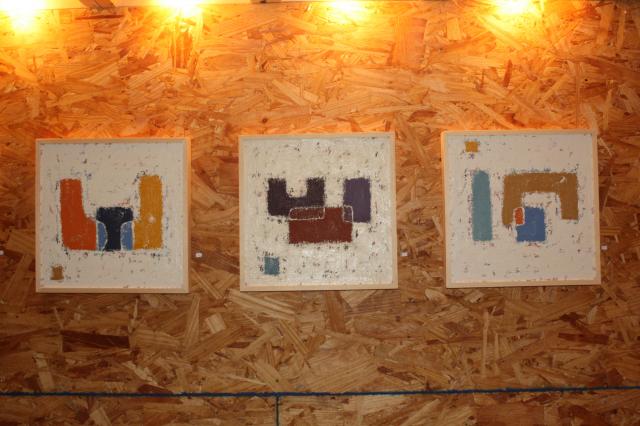
These three small paintings were painted after a trip to Greece in 1999. The blues of the Aegean sea and and the white rocks of the Greek islands were so beautiful. Shapes and colors of these paintings are a tribute to the beauty of Greece.
This series of four paintings is inspired to simple geometrical forms. Despite the minimalist look I was trying to give some sensuousness and joy these paintings
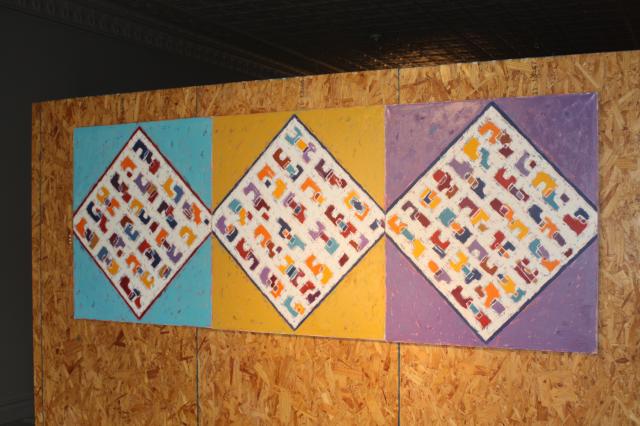
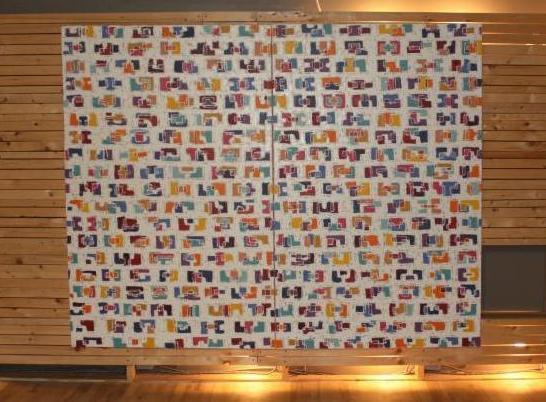
A chip consist of several layers of metallic lines separated by insulating materials. Despite the incredible complexity of a chip, the geometrical shapes used are still very simple. One of my South American friend thought that these paintings were inspired by a kind of South American Indian art. Is this art? A logical person would say :"No.. Art is a painting of a vase of flowers, a landscape or a portrait." But look how primitive these shapes are, human race never changed in thousand of years! In this sense, this is a form of art, because despite the complexity of the chips, their visual representation has always been in the human mind.
After spending some time looking at chip patterns under a microscope, shapes are still floating in my mind. The repetitive patterns are painted on a white background. They are colored with the warm blues and earth colors typical of the Italian landscape.
A series of six paintings
A series of eight paintings